Revolutionizing Insurance: The Rise of Biometric-Authenticated Claim Processing Systems

Introduction
The insurance and financial services landscapes are undergoing a profound digital transformation. As digital-first touchpoints become the norm, security, speed, and accuracy have emerged as the primary pillars of operational excellence. Among the most critical innovations driving this evolution are biometric-authenticated claim processing systems. Traditionally, insurance claim settlement has been a slow, document-heavy, and fraud-prone process, costing the industry billions of dollars annually while frustrating legitimate policyholders. By integrating advanced biometric authentication, modern insurance providers can verify identity instantly, secure data channels, and drastically reduce processing times.
But what exactly are biometric-authenticated claim processing systems, and how do they function under the hood? This article explores the mechanics, benefits, implementation challenges, and future trajectory of this disruptive technology, illustrating why it has become a must-have framework for modern insurance carriers.



Understanding Biometric-Authenticated Claim Processing Systems
At its core, a biometric-authenticated claim processing system is a modern technological framework that utilizes unique physical or behavioral human characteristics—such as facial features, fingerprints, iris patterns, or voiceprints—to verify the identity of a claimant before, during, or after the submission of an insurance claim.
By replacing traditional authentication methods like passwords, PINs, or security questions with biometric markers, these systems eliminate the vulnerabilities associated with credential theft, phishing, and synthetic identity fraud. This architecture acts as a secure digital bridge between the policyholder and the claim engine, establishing a zero-trust environment where identity claims are mathematically verified in milliseconds.
The Modalities of Biometrics in Claims Processing
1. Facial Recognition: Utilizes high-definition camera inputs to map facial features and run liveness checks to ensure a real person is initiating the claim.
2. Fingerprint Scanning: Primarily used in mobile-first applications, leveraging the secure enclaves of modern smartphones for instantaneous validation.
3. Voice Biometrics: Analyzes vocal harmonics and speech patterns, particularly useful for claims submitted via call centers or interactive voice response (IVR) systems.
4. Iris Scanning: Offers the highest level of cryptographic security, typically deployed in high-value corporate or physical branch transactions.
How the System Works: The Step-by-Step Architecture
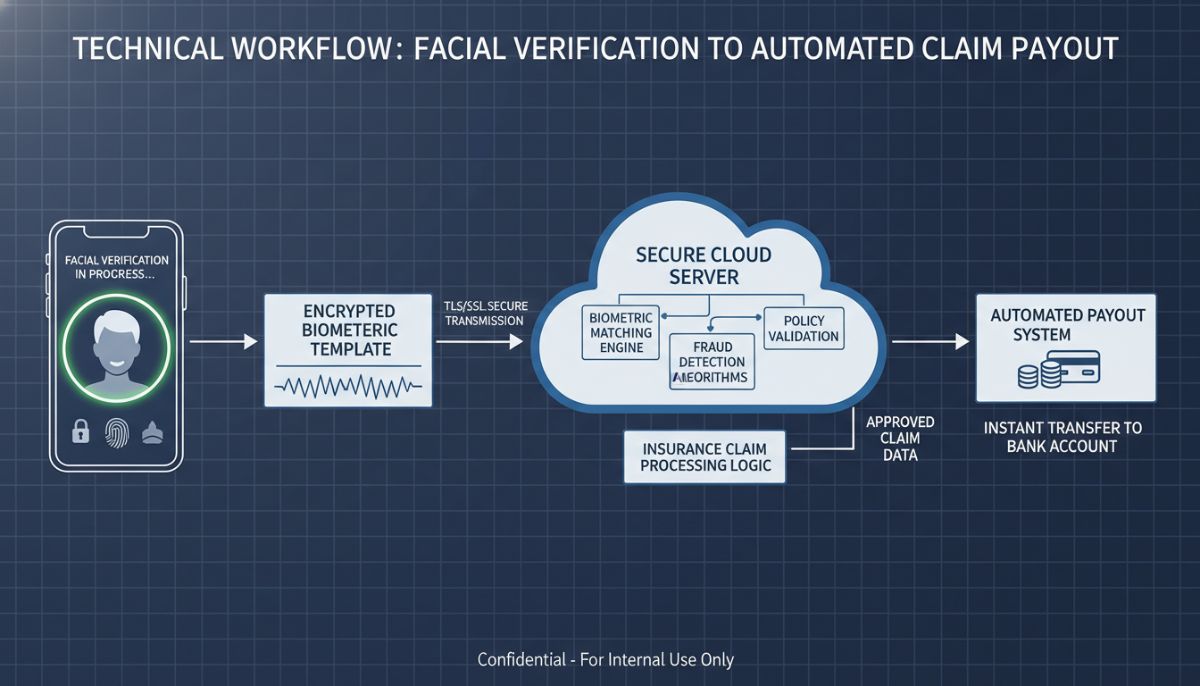
The implementation of a biometric-authenticated claim processing system transforms the legacy claim pipeline into an automated, highly secure workflow. The process can be broken down into four essential stages:
Step 1: Secure Enrollment
During the onboarding phase, policyholders enroll their biometric data through a secure application. This data is transformed into an encrypted mathematical template—rather than a raw image file—and stored securely in a decentralized database or secure local enclave.
Step 2: Claim Initiation and Biometric Verification
When an incident occurs and a claim is filed, the user is prompted to provide a live biometric scan. For instance, if a user files an auto insurance claim via a mobile app, they might take a photo of the vehicle damage followed by a quick selfie for facial recognition.
Step 3: Liveness Detection and Antispoofing
To prevent scammers from using high-resolution photos, videos, or deepfakes, advanced systems employ passive and active liveness detection. The system analyzes micro-expressions, depth, and texture to confirm the presence of a living individual.
Step 4: Straight-Through Processing (STP) and Settlement
Once the identity is authenticated and verified against the policy database, automated AI algorithms assess the claim. If the claim meets pre-defined risk criteria and identity verification is successful, the claim is approved, and funds are disbursed automatically.
The Critical Benefits of Biometric-Authenticated Claim Processing Systems
Implementing biometrics in claims processing yields massive returns for both insurers and consumers. Here is an analysis of why this technology is becoming standard practice:
1. Unparalleled Fraud Mitigation
Insurance fraud accounts for tens of billions of dollars in losses globally. Biometric-authenticated claim processing systems prevent identity spoofing, double-dipping (submitting the same claim across multiple policies), and ghost claims (claims filed by non-existent or deceased individuals).
2. Reduced Operational Costs and Friction
Traditional claims processing requires manual identity verification, often involving multiple phone calls, physical ID submissions, and notary signatures. Automating this step eliminates administrative bottlenecks, allowing human claims adjusters to focus on complex cases.
“The integration of biometrics into insurance ecosystems is no longer an optional luxury. It is a critical paradigm shift that protects corporate bottom lines while establishing the high-speed, frictionless experiences that modern consumers expect from their digital service providers.”
3. Drastically Improved Customer Satisfaction (CSAT)
Modern customers expect instantaneous service. By bypassing long verification forms and passwords, biometric claims systems can settle claims in minutes rather than weeks, dramatically boosting brand loyalty.
Comparing Traditional vs. Biometric Claims Processing
To better understand the paradigm shift, we can contrast traditional claims verification workflows with modern biometric-authenticated claim processing systems across various performance metrics:
| Feature/Metric | Traditional Claim Processing | Biometric-Authenticated Claim Processing |
|---|---|---|
| Primary Verification Tool | Passwords, PINs, physical documents, security questions | Facial scan, fingerprint, iris, voice patterns |
| Verification Speed | Hours to days (often manual check) | Near-instantaneous (less than 5 seconds) |
| Fraud Vulnerability | High (susceptible to phishing, ID theft, social engineering) | Extremely Low (secured by cryptographic biometrics & liveness check) |
| User Experience (UX) | High friction (lost passwords, manual document uploads) | Seamless, zero-friction single-touch/look activation |
| Operational Costs | High (labor-intensive manual verification) | Low (scalable, automated cloud APIs) |
| Regulatory Compliance | Fragmented, prone to human oversights | Highly standardized (fully audit-trail certified KYC/AML) |
Implementation Challenges and Strategic Solutions
Despite the clear advantages, deploying a biometric-authenticated claim processing system requires navigating several complex hurdles.
Data Privacy and Regulatory Compliance
Biometric data is highly sensitive and classified under strict regulations like the General Data Protection Regulation (GDPR) in Europe and the California Consumer Privacy Act (CCPA) in the US. Insurers must ensure that biometric data is not stored as raw images but rather as irreversible, encrypted hash templates.
System Integration and Legacy Infrastructure
Many legacy insurance core systems are built on outdated mainframe architectures that do not natively support modern API integrations. To overcome this, organizations must adopt middleware solutions or migrate to cloud-native microservices platforms that allow seamless biometric plug-ins.

Demographic Inclusivity and Accessibility
Biometric algorithms must be rigorously tested to eliminate bias based on age, ethnicity, gender, or physical disability. Systems should offer multi-modal biometric options (e.g., allowing fingerprint verification if facial recognition fails due to low light) to ensure accessibility for all policyholders.
Real-World Use Cases and Practical Applications
To understand how these concepts operate dynamically, let us look at real-world applications across various insurance domains:
Health and Life Insurance
In medical insurance, biometric claims processing ensures that the individual receiving medical treatment is the actual policyholder, eliminating healthcare identity sharing and fraud. Hospitals use biometrics during check-in to instantly authorize claims with the insurer.
Automotive Insurance
After a collision, a policyholder can capture images of the vehicle damage and submit them along with a face scan via their mobile device. The system matches the biometric signature, runs a liveness test, verifies the location metadata, and processes the micro-claim within minutes.

Travel and Micro-Insurance
Delayed flights or lost baggage claims can be validated instantly on the go. By checking the user’s travel boarding pass data and securing the request with a biometric identifier, insurers can dispense immediate payouts directly to digital wallets.
Future Trends in Biometric-Authenticated Claims Systems
The technology is rapidly evolving, driven by innovations in artificial intelligence and decentralized ledger technology.
- Decentralized Biometric Identity (DeBi): In the future, users may control their biometric templates via blockchain-backed digital identity wallets. Insurers will request verification without ever storing the biometric data on their central servers.
- Continuous Behavioral Biometrics: Moving beyond one-time authentication, future systems will monitor behavioral signals (e.g., typing rhythm, device orientation, and gesture patterns) to ensure continuous security throughout the claim journey.
- Generative AI Defense: As deepfakes become more sophisticated, biometric systems will utilize advanced generative AI models trained specifically to detect synthetic visual and auditory alterations in real time.
Conclusion
In an era where digital security and operational agility dictate market survival, biometric-authenticated claim processing systems represent the future of the insurance industry. By merging state-of-the-art cryptographic security with the effortless ease of physical verification, these systems eliminate fraud, slash operating overheads, and dramatically optimize the customer journey.
While challenges regarding data privacy and legacy integration persist, the strategic adoption of robust encryption frameworks and cloud-native solutions offers a clear path forward. Insurers who proactively adopt biometric systems today will not only secure their operations against modern threat actors but also capture the loyalty of the next generation of digital-native policyholders.