Smart Contract-Based Flight Delay Insurance: The Future of Parametric Travel Risk Management

The Evolution of Travel Insurance in the Digital Age
Air travel has become an indispensable component of global commerce and personal leisure. However, it is also notoriously susceptible to operational disruptions. Flight delays, cancellations, and missed connections cost passengers billions of dollars annually, not to mention the immense psychological distress associated with waiting in overcrowded airport terminals. While traditional travel insurance policies theoretically exist to mitigate these financial risks, the actual process of claiming compensation is notoriously tedious, bureaucratic, and slow.
In response to these systemic inefficiencies, the intersection of decentralized finance (DeFi) and InsurTech has birthed a revolutionary alternative: smart contract-based flight delay insurance. By leveraging self-executing code deployed on blockchain networks, this novel insurance model transforms a complex, paper-heavy claim process into an instantaneous, transparent, and entirely automated experience.



Understanding the Mechanics: How Smart Contract-Based Flight Delay Insurance Works
To appreciate the utility of smart contract-based flight delay insurance, one must first understand its underlying technological architecture. Unlike traditional insurance policy contracts, which are written in dense legalese and require manual verification by claims adjusters, smart contracts are digital protocols that execute automatically once predefined conditions are met.
1. Parametric Policy Creation
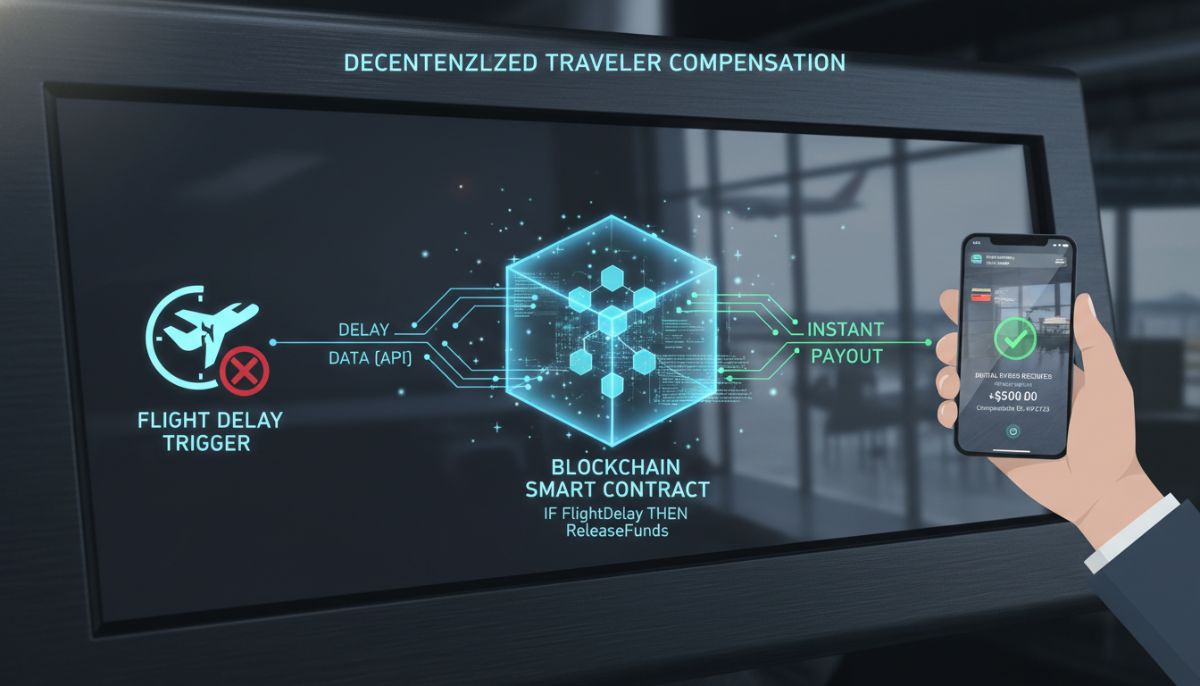
Smart contract-based flight delay insurance is a form of parametric insurance. Instead of indemnifying a policyholder for the exact subjective loss suffered, parametric policies pay out a fixed, pre-agreed amount based on an objective, measurable trigger—in this case, the duration of a flight delay. When a passenger purchases a policy, the parameters are hardcoded: for example, “if flight XYZ is delayed by more than 120 minutes, pay the policyholder 150 USD.”
2. The Crucial Role of Blockchain Oracles
A smart contract residing on a blockchain (such as Ethereum or Avalanche) is inherently isolated from external data. It cannot natively query airport departure boards or global aviation databases. To bridge this gap, the contract utilizes decentralized oracles, such as Chainlink. Oracles act as secure data pipelines that fetch real-time, verified flight status data from reputable global aviation APIs (such as FlightStats or FlightAware) and feed it directly into the blockchain.
3. Automated Execution and Immediate Settlement
The moment the flight data reaches the blockchain and confirms that the delay threshold has been crossed, the smart contract executes automatically. There is no need for the passenger to file a claim, upload boarding passes, or speak with customer service representatives. The pre-allocated funds are instantly transferred from the smart contract’s liquidity pool directly to the policyholder’s digital wallet.
Traditional vs. Smart Contract-Based Flight Delay Insurance
The differences between legacy insurance mechanisms and blockchain-enabled solutions are stark. The table below provides a detailed comparison highlighting why the industry is moving toward decentralized, parametric alternatives.
| Operational Dimension | Traditional Flight Delay Insurance | Smart Contract-Based Flight Delay Insurance |
|---|---|---|
| Claims Initiation | Manual submission of forms, receipts, and proof of delay. | Fully automated; no action required by the policyholder. |
| Verification Time | Days, weeks, or even months of manual underwriting reviews. | Instantaneous (verified in seconds via blockchain oracles). |
| Payout Speed | Delayed bank transfers or paper checks. | Immediate cryptographic token or fiat settlement. |
| Transparency | Low; terms can be obscured by subjective legal clauses. | High; code is public, immutable, and verifiable. |
| Operational Overhead | High administrative costs, driving up premium prices. | Negligible operational costs, leading to cheaper premiums. |
| Trust Factor | Relies on the insurer’s willingness and integrity to pay. | Trustless; execution is guaranteed by mathematical code. |

Key Advantages of Decentralized Parametric Solutions
The adoption of smart contract-based flight delay insurance offers profound advantages to travelers, insurers, and the broader global travel ecosystem.
Unprecedented Speed and Frictionless Customer Experience
The most immediate benefit is the elimination of post-travel administrative burdens. For a traveler stranded at a departure gate, receiving an automated payment notice on their phone provides real-time financial relief, allowing them to purchase meals, book airport lounges, or secure alternative accommodations without out-of-pocket stress.
Absolute Transparency and Trustless Integrity
In traditional insurance, disputes often arise over “force majeure” clauses or the exact definition of a delay. With smart contracts, the terms are transparently laid out in open-source code. Both parties agree on the precise data source (the oracle) that will determine the outcome. Because the blockchain is immutable, neither the insurer nor the policyholder can alter the terms or tamper with the outcome after the premium is paid.
“The true value of smart contract-based flight delay insurance lies in the elimination of the traditional claims bottleneck, transforming insurance from a reactive battle against bureaucracy into a proactive, seamless utility for the modern traveler.”
Drastic Cost Reductions
Legacy insurance companies spend massive percentages of their premium revenue on claims processing, fraud detection, and legal disputes. By automating the entire validation pipeline through software, smart contract-based platforms virtually eliminate these operational overheads. These savings are passed directly to the consumer in the form of lower premiums and higher potential payouts.
Addressing the Challenges of Decentralized Travel Insurance
While the promises of smart contract-based flight delay insurance are immense, several logistical, technical, and regulatory hurdles must be addressed before global mass-market adoption can be achieved.
1. Oracle Reliability and Single Points of Failure
The security of a parametric smart contract is entirely dependent on the integrity of the data it receives. If a malicious actor compromises the oracle or the underlying flight data API, they could theoretically trigger false payouts or prevent legitimate payouts from occurring. Ensuring decentralized, multi-source oracle consensus is vital to mitigating this vulnerability.
2. Regulatory Compliance and Legal Frameworks
Insurance is one of the most heavily regulated industries worldwide. Decentralized, autonomous platforms often clash with existing jurisdictional frameworks that require local licensing, KYC (Know Your Customer) verifications, and strict capital reserve mandates. Navigating these compliance landscapes remains a complex challenge for InsurTech startups.
3. User Experience and Web3 Onboarding
To appeal to the average traveler, smart contract platforms must mask the underlying complexity of blockchain technology. Requiring passengers to set up non-custodial Web3 wallets, purchase gas fees, and understand cryptocurrency keys creates a massive barrier to entry. Successful platforms must integrate seamless fiat-to-crypto gateways, allowing travelers to pay with standard credit cards and receive payouts in native local currencies or stablecoins.
The Road Ahead: The Future of Blockchain-Enabled InsurTech
As blockchain scalability improves and consumer comfort with digital assets increases, the market for smart contract-based flight delay insurance is poised for exponential growth. We are already seeing pioneers in the space collaborate directly with major airlines and travel booking aggregators. In the near future, purchasing flight insurance could be as simple as checking a box during checkout, with the smart contract seamlessly deployed in the background.
Furthermore, the modular nature of DeFi allows flight delay insurance to be bundled into broader decentralized travel ecosystems. Imagine a smart contract that not only pays out a claim when your flight is delayed, but also automatically reserves a room at a nearby partner hotel and books you on the next available flight—all powered by interconnected, autonomous smart contracts.
Conclusion
The traditional travel insurance paradigm is fundamentally misaligned with the speed and convenience of the modern world. By substituting human bureaucracy with cryptographic guarantees, smart contract-based flight delay insurance demonstrates how blockchain technology can solve real-world consumer pain points. As technology continues to mature and regulatory pathways clear, this automated, parametric approach will likely set a new global benchmark for transparency, efficiency, and customer satisfaction in the insurance sector.