Navigating the Skies: The Essential Guide to Autonomous Drone Delivery Liability Insurance

Introduction
The global logistics landscape is undergoing a revolutionary transformation, driven by the rapid maturation of Unmanned Aerial Vehicles (UAVs). Once a futuristic concept, autonomous drone delivery is now a commercial reality, with major retail, pharmaceutical, and logistics giants deploying fleets to solve last-mile delivery challenges. However, as the skies become increasingly crowded with autonomous aircraft, the risk landscape evolves in tandem. Operational failures, system glitches, unexpected meteorological events, and mid-air collisions present unprecedented financial and legal exposures.
For enterprises pioneering this space, securing robust autonomous drone delivery liability insurance is not merely a regulatory checkbox; it is a foundational pillar of business continuity and risk management. This comprehensive guide explores the intricacies of drone liability insurance, analyzing why specialized coverage is vital, how risks are assessed, and what the future holds for aerial logistics liability.
The Evolution of Aerial Logistics and Its Unique Risks
Unlike traditional commercial aviation or piloted drone operations, autonomous drone delivery relies entirely on pre-programmed software, artificial intelligence (AI), and real-time sensor fusion. This elimination of the human pilot in the cockpit shifts the nature of operational risk.
When a human-piloted drone crashes, liability often points to operator error. Conversely, when an autonomous delivery drone suffers a critical failure, the liability framework becomes highly complex, involving software developers, hardware manufacturers, network connectivity providers, and the fleet operator.
Key Risks in Autonomous Drone Deliveries
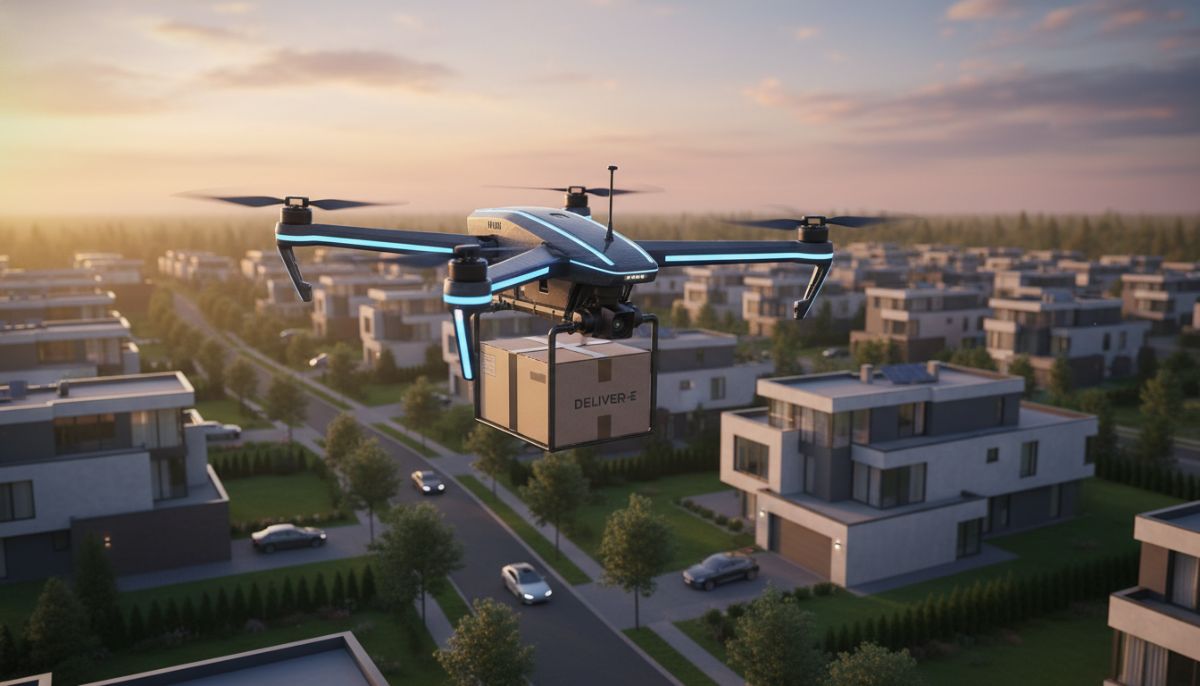
1. Third-Party Bodily Injury: A drone carrying a package that suffers a sudden power loss over a densely populated area can cause severe injury if it falls.
2. Third-Party Property Damage: Crashes can damage vehicles, residential roofs, or commercial infrastructure.
3. Privacy and Trespass Claims: Drones equipped with high-resolution cameras, LiDAR, and sensors for navigation inevitably capture data from private properties, potentially triggering civil lawsuits.
4. Cyber Security Threats: Autonomous systems are vulnerable to GPS spoofing, signal jamming, and cyber hijacking, which could lead to unauthorized control of the aircraft.
What is Autonomous Drone Delivery Liability Insurance?
Autonomous drone delivery liability insurance is a highly specialized branch of aviation insurance designed to protect businesses against third-party claims arising from drone operations. Traditional general liability (GL) policies almost universally contain “aviation exclusions,” leaving drone operators completely exposed to catastrophic financial claims.
A dedicated policy provides a financial safety net, covering legal defense costs, settlements, and medical expenses. It is structured to address both the physical operation of the aircraft and the complex digital ecosystem that keeps the drone airborne.
Standard Aviation Insurance vs. Autonomous Drone Insurance
To understand the necessity of this specialized coverage, it is crucial to analyze how it differs from traditional aviation policies.
| Feature | Standard Aviation Insurance | Autonomous Drone Liability Insurance |
|---|---|---|
| Primary Risk Focus | Human pilot error and physical aircraft hull integrity. | Software failures, algorithm glitches, and system disconnection. |
| Operational Scope | Defined flight paths with constant human monitoring. | Autonomous BVLOS (Beyond Visual Line of Sight) operations. |
| Third-Party Risks | Primarily airport and passengers. | High-density urban/suburban populations and private property. |
| Cyber Risk Coverage | Excluded or treated as a separate, unrelated policy. | Deeply integrated due to the reliance on telemetry and cloud data. |
| Regulatory Alignment | Standard civil aviation authority frameworks. | Highly dynamic frameworks (e.g., FAA Part 135, EASA SAIL). |
Core Coverage Components of Drone Liability Policies
A comprehensive insurance program for autonomous drone delivery fleets typically combines several distinct coverages:
1. Third-Party Liability (TPL)
This is the core of any autonomous drone delivery liability insurance policy. It covers legal liability for bodily injury and property damage to third parties caused by an occurrence directly related to the operation of the drone. Given the potential gravity of a mid-air collision or a ground impact, TPL limits for commercial fleets often start in the millions of dollars.
2. Hull Physical Damage Coverage
While liability coverage protects against external damage, Hull coverage protects the business’s own assets. It covers the physical loss or damage to the drone itself, its payload delivery mechanisms, and onboard sensors (such as thermal cameras or optical zoom lenses).
3. Cyber and Command Link Liability
Because autonomous drones are controlled via cloud networks, cellular connections (5G), or satellite links, they are highly susceptible to cyber-attacks. If a malicious actor hijacks a drone fleet to steal cargo or cause intentional damage, cyber liability insurance covers the resulting business interruption, data recovery, and third-party liabilities.
4. Personal Injury and Privacy Liability
Navigating urban environments requires drones to constantly scan their surroundings. This scanning can inadvertently capture footage of individuals in private spaces. Privacy liability coverage protects operators from claims of trespass, nuisance, or invasion of privacy.

Underwriting Criteria: How Insurers Assess Autonomous Risk
Because autonomous delivery is a relatively new industry, underwriters do not have decades of actuarial data to rely on. Consequently, they conduct highly rigorous, technology-focused risk assessments to determine premiums and coverage limits.
“The underwriting of autonomous flight is shifting from evaluating human pilot hours to auditing the redundancy of software architecture, fail-safe protocols, and the cyber-resilience of the operational network.”
Underwriters typically scrutinize the following factors:
- The Autonomy Stack and Redundancy: Insurers want to know what happens when a primary system fails. Does the drone have redundant batteries, motors, GPS modules, and flight controllers? Does it feature a ballistic parachute recovery system?
- BVLOS Approvals and Certifications: Operators holding advanced regulatory certifications, such as the Federal Aviation Administration (FAA) Part 135 air carrier certificate in the United States, are viewed as lower-risk profiles.
- Geofencing and Path Planning: Advanced software that prevents drones from entering restricted airspace (airports, military installations) or flying directly over crowded public events reduces risk profiles significantly.
- Historical Telemetry Data: Operators who can provide clean, historical data proving low incident rates across thousands of autonomous flight hours will secure far more favorable terms.
- Dynamic, Usage-Based Premiums: Rather than static annual policies, future insurance may leverage real-time telemetry. If a drone flies in perfect weather over a low-density rural area, the premium for that specific flight will be lower than a flight conducted during high winds over a metropolitan center.
- Consolidated Product Liability: As autonomous systems become more cohesive, we may see a shift from operator liability to manufacturer and software developer product liability, simplifying the claims process for fleet operators.
- Global Standardized Risk Modeling: As data pools grow, standard risk indexes for autonomous flight will emerge, leading to more predictable premium rates across the global market.
Legal and Regulatory Frameworks Driving Insurance Demand
Regulatory compliance is inextricably linked to insurance. In most jurisdictions, civil aviation authorities will not grant operational authorization for BVLOS drone deliveries without proof of adequate liability insurance.
In the United States, the FAA continues to refine rules for commercial drone integration. Similarly, the European Union Aviation Safety Agency (EASA) utilizes the Specific Operations Risk Assessment (SORA) framework, which directly correlates operational risk levels with mandatory insurance minimums. Businesses must keep a close eye on these evolving standards, as a failure to comply can instantly void an active insurance policy.
Future Trends in Autonomous Drone Insurance
As artificial intelligence advances, the insurance market will adapt in several key ways:
Conclusion
The commercialization of autonomous drone delivery promises to redefine global logistics, offering unprecedented speed and environmental efficiency. However, unlocking this potential requires a sophisticated approach to risk mitigation.
Securing a tailored autonomous drone delivery liability insurance policy is not just a mechanism to absorb financial shock; it is a strategic asset that builds trust with regulators, investors, partners, and the general public. As the industry scales, those operators who proactively manage their cyber, physical, and operational liabilities will ultimately lead the skies of tomorrow.